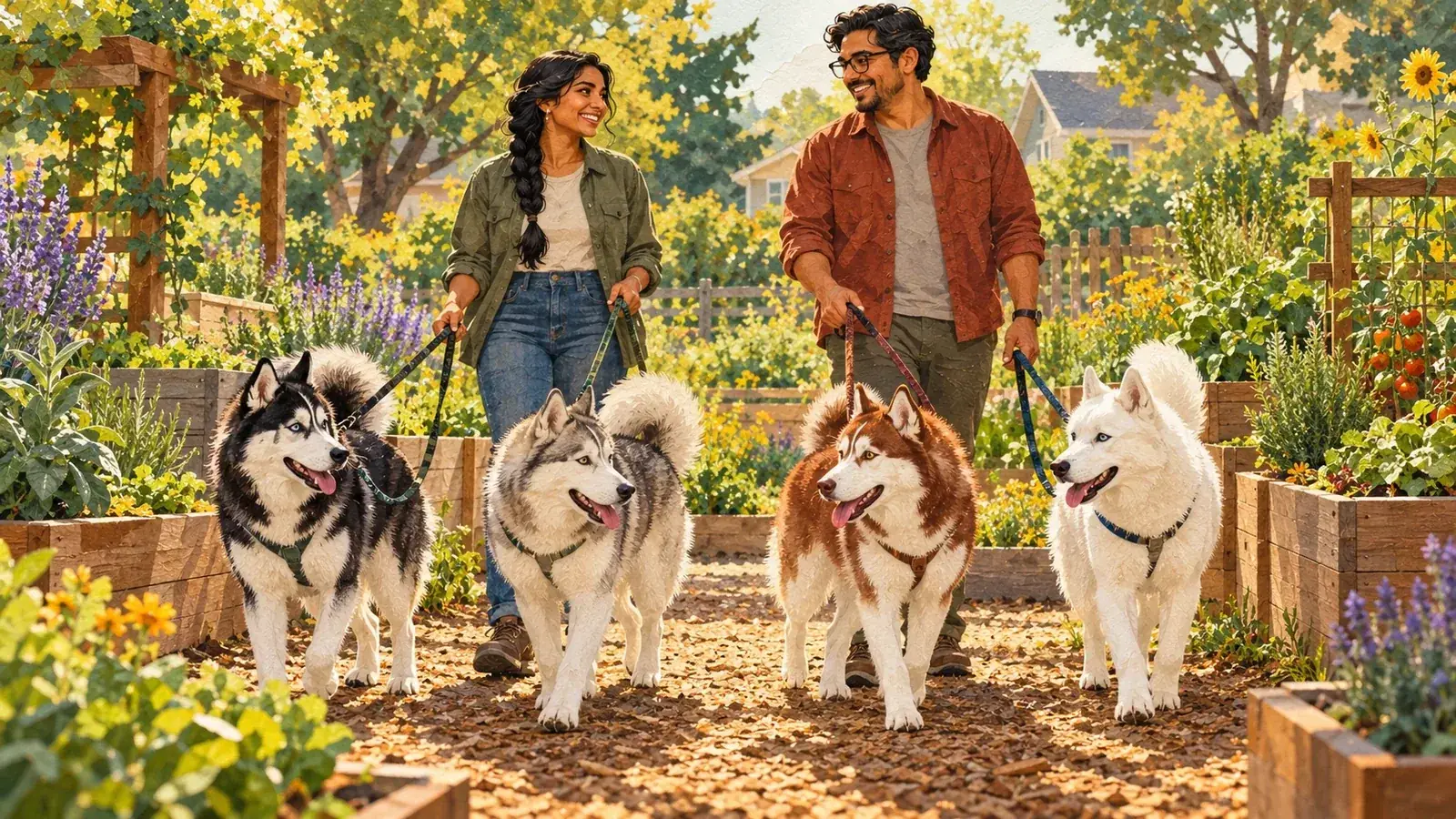

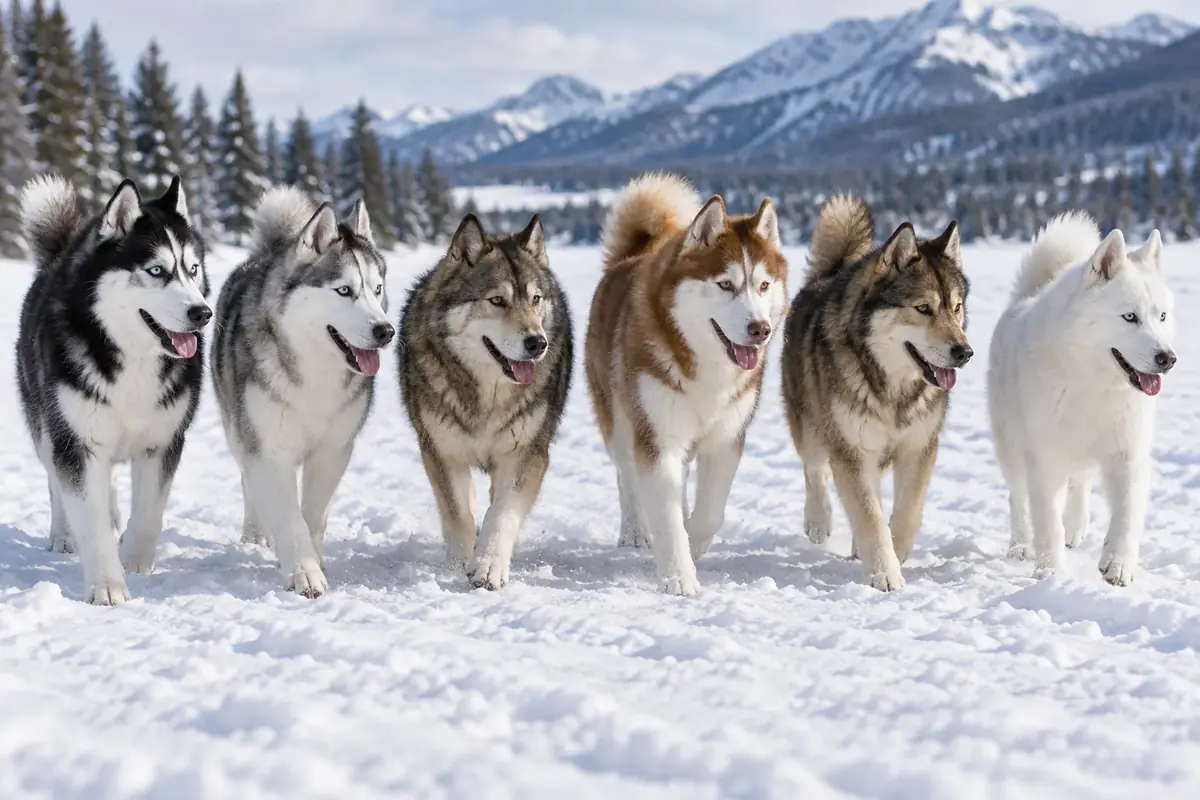
Siberian Huskies come in black, gray, agouti, sable, red and white, in every shade within those colors, with or without white markings. The AKC breed standard names those six colors and allows "all ranges" of them, so a pale silver dog, a deep copper dog and an all-white dog are all correct. It also gives no preference to any one color over another.
The exceptions are two patterns. The standard disqualifies merle and brindle, so a Husky advertised with either is worth a closer look at its background before anything else.
Husky colors at a glance
| Allowed colors | Black, gray, agouti, sable, red and white, in all shades |
|---|---|
| White markings | Common and allowed, including piebald patches |
| Preferred color | None; the standard treats every allowed color equally |
| Ruled out | Merle and brindle patterns |
| Nose color | Black in most dogs, liver in reds, black, liver or flesh in whites |
| Eye color | Brown, blue, one of each, or parti-colored |
The six colors in the standard
The Siberian Husky standard, written by the Siberian Husky Club of America and published by the AKC, keeps its color rule short (see Can a Siberian Husky be merle). It allows "all ranges" of black, gray, agouti, sable, red and white. That one phrase covers a lot of ground, because each color shows up in many shades. Gray can be nearly silver or a dark, smoky wolf gray. Red can be a light copper or a deep rust.
Most Huskies wear more than one of these at once. The double coat helps here: the outer guard hairs and the softer undercoat underneath are often different shades, and the white areas on the face, legs and belly frame the whole thing. The descriptions below are the typical look, though plenty of dogs fall somewhere in between.

| Color | Typical look |
|---|---|
| Black | Dark guard hairs, usually with white on the face, legs and chest |
| Gray | Silver through wolf gray, the look most people picture first |
| Red | Copper to deep rust, with a liver-colored nose |
| Sable | Reddish base with darker tips on the guard hairs |
| Agouti | Banded hairs and a dark, smoky face with a wild look |
| White | All white, sometimes with light cream shading |
Noses and eyes follow their own rules
The standard also ties nose color to coat color. According to the AKC standard, the nose is black in black, gray, sable and agouti dogs and liver in red dogs, while white dogs may have a black, liver or flesh-colored nose. That makes the nose a handy clue when a coat is hard to name, since a coppery dog with a liver nose reads as red, not sable.
Eyes are a separate matter entirely. The standard allows brown or blue eyes, one of each, or parti-colored eyes with both colors in a single eye, and eye color doesn't need to match the coat in any way. A red dog can have ice-blue eyes and a black dog can have brown. Coat and Husky eye colors are inherited separately, so almost any pairing is possible.
Markings, patterns and piebald
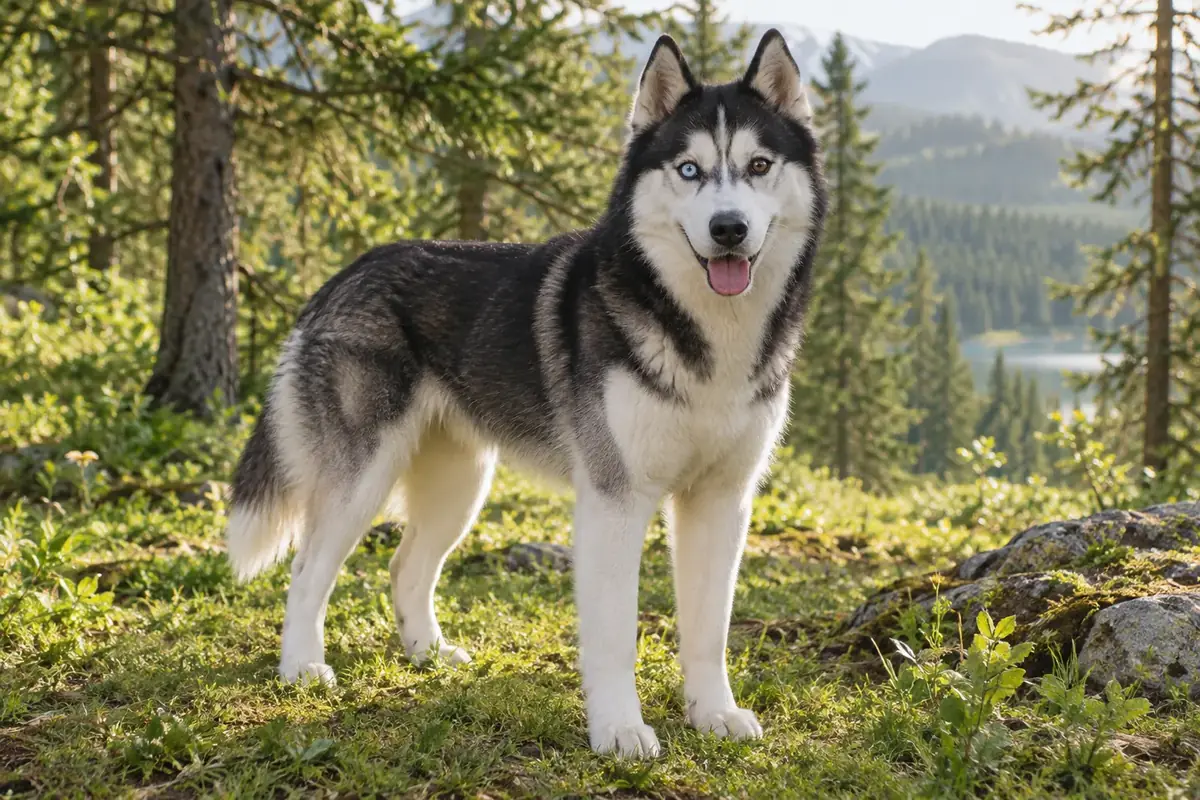
Color is only half of how a Husky looks. The SHCA notes that a variety of symmetrical and asymmetrical markings and patterns are common, including piebald (see What do the markings on a Husky's face mean). A piebald Husky is mostly white with patches of color, and the club describes the patches as banded guard hairs amid white.
Faces add even more variety. Owners talk about open faces, full masks, goggles around the eyes, caps and widow's peaks, and two littermates can look nothing alike. None of these markings ranks above another under the standard.
Open face
Mostly white face with color mainly on the top of the head and ears.
Mask or goggles
Darker color around the eyes, sometimes with a white bar between them.
Piebald
A largely white body with patches of colored, banded hair.
Saddle back
A darker, saddle-shaped area of color across the back.
The two patterns the breed rules out
The standard names merle and brindle as disqualifications, and the SHCA spells out what each one means. Merle is a marbling effect of dark patches against a lighter background. Brindle is darker and lighter single-colored guard hairs that produce a vertical tiger striping.
The club also points out that piebald should not be confused with either one. Patches of color on a white Husky are normal. Marbled or striped coloring isn't part of the breed's accepted range, so a "merle Siberian" listing is a good reason to ask careful questions about the parents. Those questions matter because merle Huskies raise real doubts about ancestry.
Allowed
- Any shade of the six colors
- White markings anywhere
- Piebald patches on white
- Masks, goggles and caps
Disqualified
- Merle marbling
- Brindle striping
How coat color genes work, in plain terms
Every Husky color starts with just two pigments. UC Davis's Veterinary Genetics Laboratory explains that dogs have eumelanin, which is black, and phaeomelanin, which is red or yellow. Different genes then decide which pigment is made where, and how it's modified.
A few of these genes do most of the work. The E locus controls whether a dog can make eumelanin at all, and the VGL notes that dogs with two copies of the recessive e variant can't produce it, so they show only phaeomelanin. The A locus, or Agouti gene, controls switching between the two pigments and produces patterns that include sable, agouti, and black and tan. Other genes, such as the brown (B) and dilute (D) loci, change how the dark pigment looks.
Because some of these variants are recessive, a dog can carry one copy without showing it. That's how two parents can produce a puppy in a color neither of them wears. The A locus is also behind the banded, wild look of agouti Huskies.
Why no color is worth paying more for
The SHCA puts it plainly: no preference should be given to any allowable color, marking or pattern. A red or agouti puppy isn't more correct than a classic gray-and-white one.
What does matter for the next decade or more is the parents' health testing, their temperaments, and how the litter was raised. A breeder who talks a lot about "rare" colors and very little about health screening is telling you something about their priorities. Pick the puppy whose personality fits your home. The coat will be gorgeous either way, and it will be on your couch either way too.
About rare colors
Colors with marketing names like "rare" or "exotic" are still just the same six colors in different shades. A higher price tag for a shade is not a sign of a better dog.
Describing your own Husky's color
A clear, consistent description is useful for vet records, microchip registration and, if it ever came to it, a lost-dog poster. It also settles friendly arguments at the dog park.
- Look outdoors in daylight. Indoor lighting and phone cameras can make gray look blue and red look orange.
- Check the guard hairs. Note the darkest hairs along the spine and shoulders.
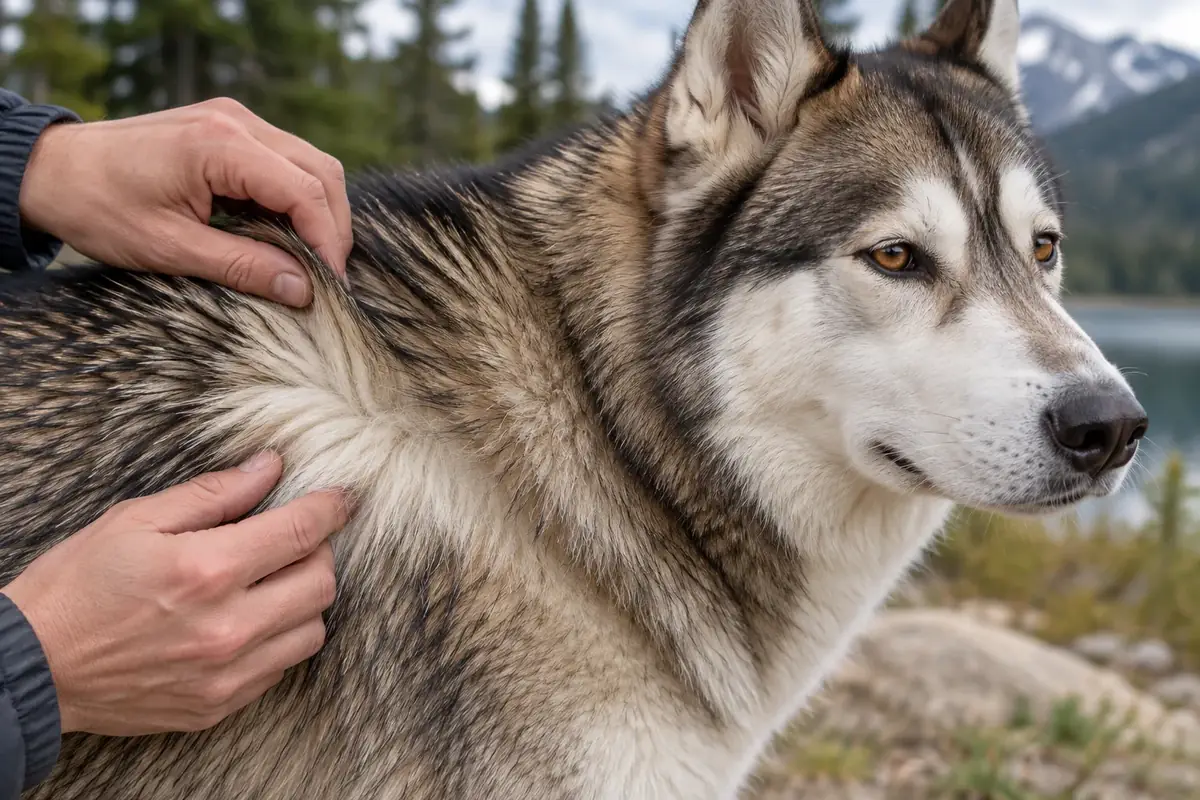
- Part the coat. Look at the undercoat underneath, which is often lighter or warmer.
- Check the nose. Black or liver is a strong hint between gray, sable and red.
- Map the white. Note the face, chest, legs, belly and any larger patches.
- Write one line. For example, gray and white, open face, black nose, one blue and one brown eye.
Husky color questions
Short answers to the questions owners ask most.
Which Husky color is most common?
Gray and white and black and white are the looks most people picture, and both are very common. The standard doesn't favor them, though; every allowed color is equally correct.
Can a Husky be solid white?
Yes. White is one of the six allowed colors. White Huskies may have a black, liver or flesh-colored nose under the standard.
Does coat color affect personality?
There's no good evidence that an allowed coat color changes temperament. Genetics, upbringing and training shape personality. The paint job stays out of it.
Are merle Huskies purebred?
Merle is a disqualification in the Siberian Husky standard and isn't part of the breed's accepted colors. A merle dog is worth asking hard questions about.
Can a DNA test tell me my dog's color genes?
Coat color tests from labs such as UC Davis's VGL can report several color genes. They describe what a dog carries, which is useful for breeders and fun for curious owners.
One small move for today
Next time you brush your Husky, part the fur along the back and compare the undercoat to the guard hairs on top.
Sources and further reading
The research and expert guidance behind this page, if you want to dig deeper.
- American Kennel ClubOfficial Siberian Husky breed standard, including colors, nose and eye color, and disqualifications
- Siberian Husky Club of AmericaBreed club explanation of allowable colors, piebald, merle and brindle
- UC Davis Veterinary Genetics LaboratoryOverview of dog coat color genetics, pigments and the main color genes
Still curious?
 Senior HuskiesCan old Huskies get dementia?
 Husky 101Stuck inside again? What keeps a Husky busy indoors?
 BehaviorWhy does my Husky get the zoomies?
 TrainingShould a Husky wear a harness or a collar?
 Health & CareDoes my Husky have an ear infection?
 GroomingHow often should you brush a Husky?