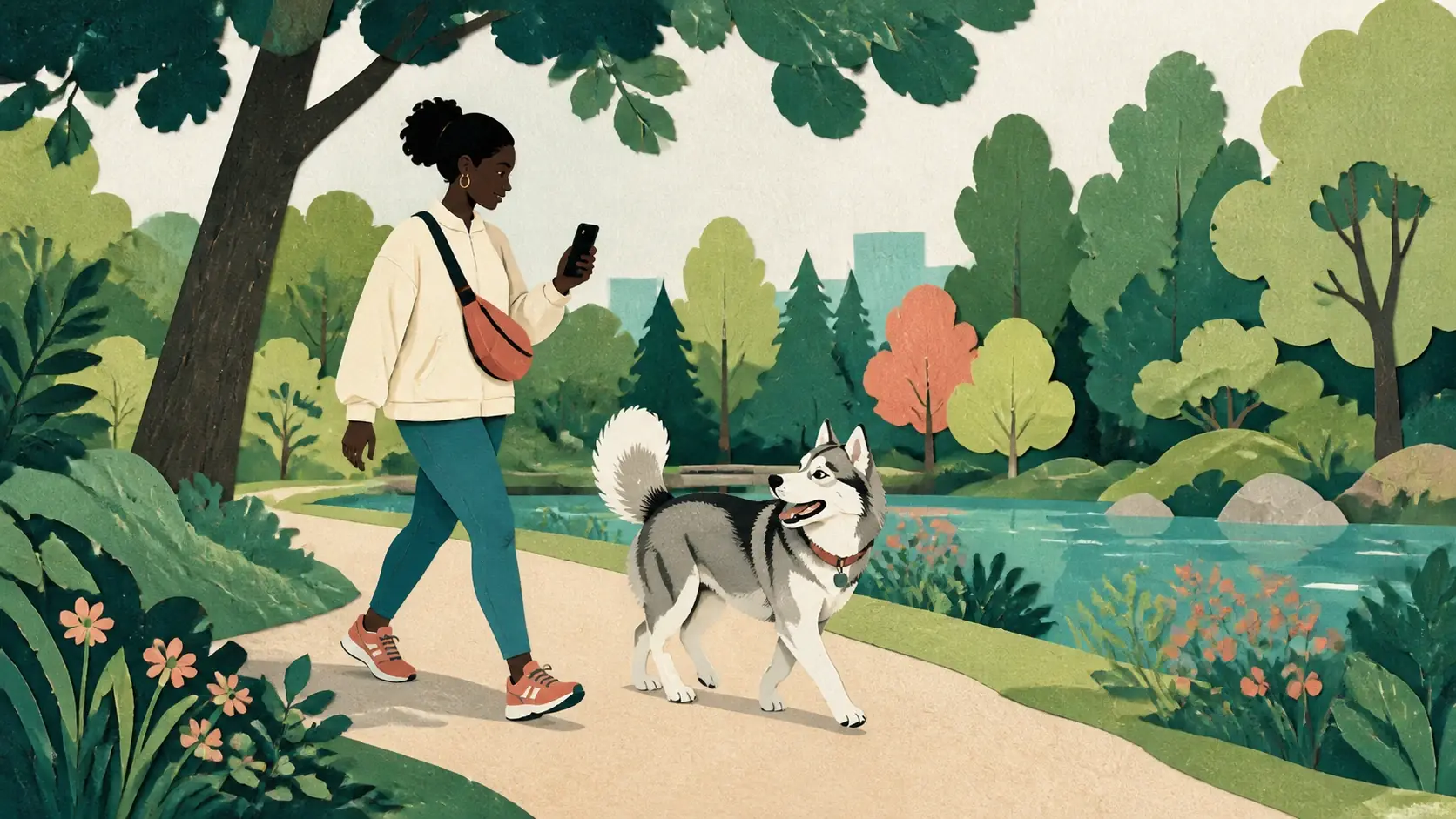

Great Husky photos come from soft natural light, a camera held at your dog's eye level, focus locked on the eyes, and short bursts of shots taken while a treat or a squeak holds their attention just above the lens. Timing and patience do most of the work, and most frames will end up deleted. That's normal.
The main exception to "anything for the shot" is safety. Keep sessions brief, stop when your Husky shows signs they're done, and never trade a leash, a cool car or solid footing for a better picture.
Husky photos at a glance
| Best light | Early morning, late afternoon or open shade |
|---|---|
| Camera height | Down at your dog's eye level |
| Focus point | The eye closest to the camera |
| Getting the look | A treat or squeak held just above the lens |
| Moving dogs | Burst mode, then keep the best frame |
| Session length | A few minutes, ended while it's still fun |
Light that flatters a double coat
Light does more for a dog photo than any camera upgrade. The hour or so after sunrise and before sunset gives warm, low light that brings out texture in fur without harsh contrast. Midday sun is the hardest to work with. It throws dark shadows under the brow, makes your dog squint, and can turn a white face into a featureless bright patch.
When the sun is high, look for open shade, such as the shady side of a building or the edge of a tree line where your dog is out of direct sun but still facing open sky. Indoors, a large window is your best friend. Put your Husky beside it rather than with the window directly behind them, and switch off yellow overhead lights so the coat keeps its true colors.
If the light looks kind on a person's face, it will usually look kind on your dog too.
Getting down to Husky height
Most dog photos are taken from standing height, which mostly shows the top of a head and a pair of hopeful eyes. Crouch, kneel or lie on the ground so the lens sits level with your dog's eyes. The photo instantly feels more personal, as if you've stepped into their world for a moment.
Angles below eye level are worth a try as well. Shooting slightly upward against the sky makes a Husky look grand, a little wolfish and very pleased with themselves.
Eye level
The most natural and personal view, good for portraits and expressions.
Slightly below
Adds drama and a heroic feel, especially outdoors against open sky.
Straight down
Best saved for details, like a curled-up nap or paws in fresh snow.
Sharp eyes and those famous blue ones
A photo feels alive when the eyes are sharp, even if the tail is a blur. On most phones, tap the screen on the eye nearest the camera before you shoot. Portrait mode can soften a busy background nicely, though fluffy ears and whiskers sometimes confuse it, so check the edges. Leave a little space in front of your dog's face in the direction they're looking.
Light blue eyes can look washed out or almost glowing in bright sun, and soft light or shade keeps their color rich. Huskies come in a range of brown, blue and mixed eye colors, including bi-eyed combinations. Whatever the color, a small sparkle of reflected light in the eye, called a catchlight, makes a portrait pop. Facing your dog toward a window or open sky usually creates one.
That eerie glow you sometimes get with a flash has a simple cause. A veterinary ophthalmologist quoted in Scientific American explains that dogs have a reflective layer at the back of the eye, the tapetum, which bounces light back out. Natural light avoids the effect, and it also spares a dog the sudden pop of a flash, which some find startling.
Snow, sun and white fur
Snow scenes are some of the best Husky photos you'll ever take, and some of the trickiest. Cameras try to average out all that brightness, so snow often comes out a dull gray and your dog looks dim. On most phones you can tap to focus, then slide the exposure control brighter until the snow looks white again.
Don't push it too far, though. White and pale gray coats lose detail quickly when the picture is overly bright, so watch the fur on the face and chest as you adjust. Overcast winter days are a gift here, because the soft light keeps both snow and coat in check.
Keep winter sessions short and moving. Most Huskies are perfectly happy in the cold, but your fingers and phone battery may not be.
- Brighten exposure a little when snow looks gray
- Check white fur for lost detail after adjusting
- Use overcast days for soft, even winter light
- Keep a spare battery or charger in a warm pocket
- Shoot snow zoomies in burst mode
Treats, squeaks and the head tilt
To get your Husky looking at the camera, hold a treat or squeaky toy right above the lens. A quick squeak, a silly noise or a favorite word can earn the classic head tilt. Use each sound sparingly. Huskies are clever and figure out a repeated trick fast, and a sound that worked three times may earn only a bored look on the fourth.
Reward often so the session feels like a game your dog is winning. A helper standing behind you with the treat frees your hands for the camera. Tiny, soft training treats work best, and they still count toward the day's food. The AKC recommends keeping treats to no more than 10 percent of your dog's daily calories, so a photo afternoon may call for a slightly smaller dinner.
Timing trick
Save the most exciting sound for the moment you're ready to shoot. A squeak used while you're still fiddling with settings is a squeak wasted.
Burst mode and a little patience
Dogs move fast, and burst mode captures a run of frames in a second or two. On many phones you hold the shutter button or slide it sideways to start a burst. Afterward, scroll through and keep the one where ears, eyes and expression all line up.
Action shots of running and play are far easier this way. Try to have the light coming from behind you or to the side, and let your dog move across the frame rather than straight at you, which gives the focus a better chance to keep up. Then delete freely.
| Phone feature | What it does for Husky photos |
|---|---|
| Burst mode | Catches the split second when ears perk and eyes connect |
| Tap to focus | Locks sharpness on the eyes instead of the nose or grass |
| Exposure slider | Keeps snow white and pale coats from losing detail |
| Portrait mode | Softens a cluttered background behind a still dog |
| Grid lines | Helps keep horizons level and the face well placed |
Backgrounds and grooming before the shoot
A busy background can swallow even the most striking Husky. Look for something plain, such as a hedge, a weathered fence, an open field or clear sky. Contrast helps a lot. A black and white dog pops against green grass or autumn leaves, while a pale coat stands out best against darker tones (see What are the best treats for a Husky). Glance behind your dog's head for a pole that seems to grow out of an ear.
A quick brush before a planned session makes a real difference, because loose undercoat shows up in photos far more than it does in person. Brushing a Husky with an undercoat rake gets most of it out. Wipe away any eye gunk and pick out leaf bits, then let your dog shake before you start.
Keeping the session safe and fun
Five minutes of playful photos usually beats twenty minutes of asking for a sit-stay. Watch for signs your dog has had enough. Purdue University's Center for Animal Welfare Science lists lip licking, yawning, turning or looking away and shaking off among the signals of stress or discomfort. End on a good note, with a treat and some play.
No photo is worth unclipping a leash in an unfenced area. Plenty of Huskies have a strong urge to run and a recall that falls apart at the sight of a squirrel, so a long line is a better choice than trust. Solid Husky recall training takes time, so keep the line on while you build it. Skip cliff edges, busy roads, thin ice and fast water, however dramatic the backdrop.
Never leave your dog in a parked car while you scout a location or set up gear. The AVMA notes that the temperature inside a car can rise almost 20 degrees Fahrenheit in just 10 minutes, and that cracking the windows makes very little difference. If your dog seems overheated, lethargic or unwell during an outing, stop and call your vet.
Husky photo questions
What owners ask when the camera comes out.
Do I need a fancy camera for good Husky photos?
No. A modern phone handles most situations well. Good light, a low angle and sharp eyes matter far more than the camera.
Is flash bad for my dog's eyes?
An occasional flash isn't known to harm a dog's eyes, but it can startle some dogs and causes that glowing eye effect, so natural light is the easier and calmer choice.
Why does my Husky look away every time I lift my phone?
Some dogs find a phone pointed at them a little odd, and looking away can be a sign of mild discomfort. Pair the phone with treats and play so it starts to predict good things.
How do I photograph a Husky who won't sit still?
Stop asking them to. Use burst mode during play, and save posed portraits for when they're tired after a walk.
How can I get my Husky's blue eyes to show up?
Shoot in shade or soft light, face your dog toward a bright window or open sky for a catchlight, and tap to focus on the nearest eye.
A practical little next step
On your next walk in good light, crouch to eye level once and take a single burst of your Husky, then reward them for being a star.
Sources and further reading
The research and expert guidance behind this page, if you want to dig deeper.
- AVMAPets in vehicles, including how quickly a parked car heats up
- American Kennel ClubHow many treats a dog can have and the 10 percent calorie rule
- Purdue University Center for Animal Welfare ScienceCanine body language and signs of stress or discomfort
- Scientific AmericanWhy dogs' eyes glow in flash photos, with a veterinary ophthalmologist
Keep sniffing
 Husky LifeShould you take your Husky on vacation or board them?
 Husky LifeDo Huskies like water?
 TrainingWhy won't my Husky listen?
 Health & CareWhat vaccines does a Husky need?
 GroomingWhat is the best brush for a Husky?
 Food & FeedingWhat's the safest way to switch my Husky's food?